Content |
|
|
| |
Introduction |
 |
 |
|
| |
| When infrared energy strikes an object it is either absorbed, transmitted or reflected from the surface.
Most materials encountered in industry are best suited for infrared heating as their maximum absorption occurs amidst the
infrared spectrum at wavelengths between 2 - 10 mm. As infrared is a non-contact heating process, there is a rapid
energy transfer from the heater to the product. Infrared heaters can be operated in vacuum or atmosphere. |
| |
3.1 Ceramic Infrared Emitters |
 |
 |
|
| |
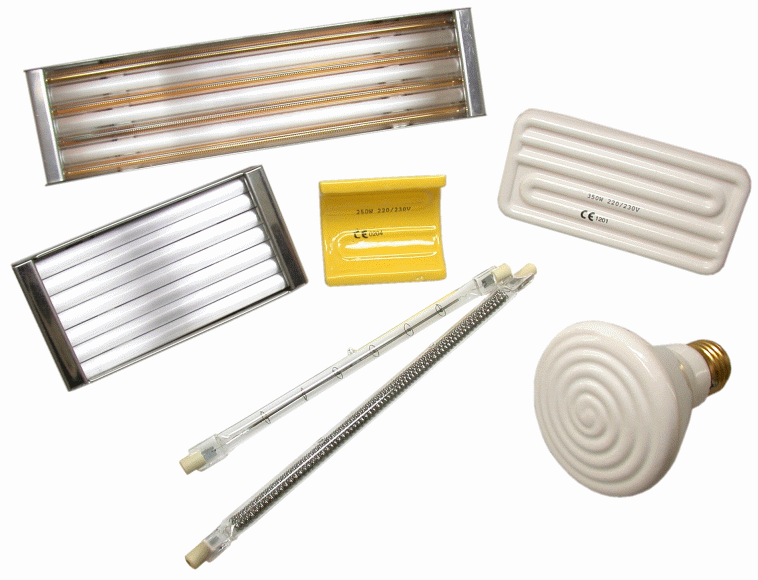
| Ceramic Infrared Emitters are robust, standardized and competitively priced.
With 2.5 - 10 mm their emitted wave length spectrum is as widely spread as
their span of applications. That ranges from infrared heaters for changing tables or infrared cabins to heat
bridges in canteens or room heating at the work place to thermoforming machines for plastic packaging or rotary
furnaces to dry bulk materials. Ceramic Infrared Emitters are available as Solid Ceramic Emitters
or Hollow Ceramic Emitters with and without thermocouple.
The hollow element distinguishes itself by its especially short heat up and cool down times and
a better efficiency in infrared heat transfer to the front. Anyway, by using a reflector
even with the Solid Ceramic Emitter more than 95% of the total radiation output can be directed to the front.
|
| |
|
| |
3.1.1 Solid Ceramic Emitters |
 |
 |
|
| |
|
At emitter temperatures between 300°C and 750°C (575°F – 1382°F) Solid Ceramic Emitters produce
long and medium wavelengths from 2,5 - 10 microns. Because of their broadband emission spectrum and their excellent
characteristics such as a long life, easy interchangeability and exact heat positioning, Solid Ceramic Emitters are used
in many different applications. Classic examples are thermoforming, paint curing, printing and drying. They are also used
very effectively in Infrared Patio Heaters and Infrared Saunas. The glazed ceramic surface protects from oxidation and corrosion.
Standard execution is a moulded connection block including wave and spring clips and 100 mm leads
(150 mm for SFSE and all yellow coloured elements) with ferrule (optional: ring terminal). |
| |
|
|
| |
| Type |
Dimensions |
Power at (230V) other voltages and wattages on request |
FTE* (Full Trough Element)
FTELN (Full Trough Ele. Long Neck)
FFE* (Full Flat Element)
FFES (Full Flat Element Slim) |
245 x 60 x 31 mm 245 x 60 x 62 mm 245 x 60 x 24 mm 245 x 40 x 24 mm
|
150W, 250W, 300W, 400W, 500W, 650W, 750W, 1000W (FFES max. 650W)) |
HTE* (Half Trough Element)
HFE* (Half Flat Element) |
122 x 60 x 31 mm 122 x 60 x 24 mm |
125W, 150W, 200W, 250W, 325W (HTE), 500W |
QCE (Quarter Curved Element)
QTE (Quarter Trough Element)
QFE (Quarter Flat Element) |
60 x 55 x 40 mm 60 x 60 x 31 mm 60 x 60 x 24 mm |
125W, 250W |
| SFSE* (Square Flat Solid Element) |
122 x 122 x 24 mm |
150W, 250W, 300W, 350W, 400W, 500W, 650W, 750W |
LFTE (Large FTE)
LFFE (Large FFE) |
245 x 110 x 37 mm 245 x 95 x 24 mm |
LFTE: 1000W, 1500W LFFE: 150W, 350W, 750W, 1400W |
|
* with UL approval (UL-Number: 120601-E214574) Selection aids see chapter 3.6 Service |
| |
|
» recommended radiation distance: 100 - 200 mm
» standard colour: white (yellow, pink, black); in hot state turns yellow light brown and pink grey
» Standard-TC: type K "Cerix" (optional: type J)
|
| |
3.1.2 Hollow Ceramic Emitters |
 |
 |
|
| |
|
The high efficient Hollow Ceramic Emitter is an innovation of the conventional Solid Ceramic Emitter.
Due to low thermal mass and therefore 40% shorter heat-up time it is used in cyclic or intermittent processes.
Because of the inbuilt cavity barrier fewer energy gets lost at the back which improves the heater’s efficiency.
Thus, over 15% electrical energy can be saved. Standard execution is a moulded connection block including wave and
spring clips and 150 mm leads with ferrule (optional: ring terminal). The infrared heater with E27-fitting is an easy
installing specimen of a Ceramic Hollow Emitter. It is used for animal-breed or any draughty areas. |
| |
|
|
| |
| Type |
Dimensions |
Power (at 230V) other voltages and wattages on request |
| FFEH (Full Flat Element Hollow) |
245 x 60 x 36 mm |
250W, 300W, 400W, 500W, 600W, 800W |
| HFEH (Half Flat Element Hollow) |
122 x 60 x 36 mm |
125W, 200W, 250W, 300W, 400W |
| SFEH |
122 x 122 x 36 mm |
250W, 300W, 400W, 500W, 600W, 800W |
| ESE-B (-Baby)* |
Ø 63,5 x 137 mm (E27) |
60W, 100W |
| ESE-S (-Small)* |
Ø 80 x 108 mm (E27) |
60W, 100W |
| ESE-R (-Regular)* |
Ø 95 x 140 mm (E27) |
150W, 250W |
| ESE-XL (-Extra Large)* |
Ø 137,5 x 135 mm (E27) |
500W |
|
* Edison Screw Element
Selection aids see chapter 3.6 Service |
| |
|
» recommended radiation distance: 100 - 200 mm
» standard colour: white (yellow, pink, black); in hot state turns yellow light brown and pink grey
» Standard-TC: type K "Cerix" (optional: type J)
|
| |
3.1.3 The "Cerix" Thermocouple |
 |
 |
|
| |
|
In many of today’s industrial heating processes some form of temperature control may be required.
The parameters for an accurate thermocouple are: rapid response, perfect protection against electrical interference
and a fixed distance to the heat source. The patented CERIX technology uses the perfect combination of attributes of
quartz glass regarding heat conductivity and electrical insulation. By threading a clear quartz tube over the heating
coil and attaching the thermocouple type K (NiCr-Ni) directly to the tube, the heat is rapidly transferred into the thermocouple
and so the temperature change in the element is closely followed. This assembly with its ever same positioned thermocouple
junction guarantees reproducible temperature measurements with very little deviation between different elements. Thermocouple Typ J (Fe-CuNi)
is available on special request (not in Cerix technology). |
| |
|
|
| |
3.1.4 Reflectors |
 |
 |
|
| |
|
An integral part of any infrared heating element is the reflector. By mounting the infrared element
in a reflector the overall efficiency of the heater can be greatly improved. The reflector’s polished aluminium surface
provides for optimal reflectivity and hence minimal heat loss, while its steel body imparts additional strength and rigidity
to the entire assembly. In addition to our standard reflector we offer as well a thermally insulated execution. Reflectors are
supplied incl. a ceramic connector block and 300 mm high temperature leads. The IR emitters are not included in delivery.
They have to be ordered separately. |
| |
|
|
| |
| Type |
Dimensions |
| RAS S* |
92 x 44 x 250 mm |
| RAS 1 |
100 x 62 x 254 mm |
| RAS 2 |
100 x 62 x 504 mm |
| RAS 3 |
100 x 62 x 754 mm |
| RAS 4 |
100 x 62 x 1004 mm |
| RAS 5 |
100 x 62 x 1254 mm |
|
|
| Type |
Dimensions |
| |
|
| RASiso 1 |
100 x 60 x 254 mm |
| RASiso 2 |
100 x 60 x 504 mm |
| RASiso 3 |
100 x 60 x 754 mm |
| RASiso 4 |
100 x 60 x 1004 mm |
| RASiso 5 |
100 x 60 x 1254 mm |
|
|
* without ceramic connector and leads Other dimensions by request By special request all reflectors are available as well in stainless steel. |
| |
3.2 Quartz Infrared Emitters |
 |
 |
|
| |
| Quartz Infrared Emitters have a similar emission spectrum to Ceramic Infrared Emitters regarding medium
and long wave infrareds. The difference make the short wave emission fractions between 1 and 3 mm which the Quartz Infrared Emitters additionally possess. Despite many intersections
the span of applications of both emitter types differ (see selection assistance in chapter 3.6 Service). Due to their short response
time, Quartz Infrared Emitters are especially recommended for cyclical or often interrupted processes. They are available as IRCassettes
or single IRTubes. The Quartz IRCassettes are compatible to the Ceramic Infrared Emitters and can be installed in the same way with the
Quick Plug System "PxQE". For high temperature applications we recommend our Xtreme option with stainless steel cassette and/or gold coated quartz tubes. |
| |
|
| |
3.2.1 Quartz IRCassettes |
 |
 |
|
| |
| Quartz Infrared Cassettes provide infrared radiation in the medium wavelength
range of 1.3 to 9 mm depending on the working temperature. They are favoured in industrial appliances where
rapid heater response is necessary. All Quartz Heaters are encased in a highly reflective aluminised steel body.
Quartz elements can also be supplied with a built-in type K thermocouple. Standard execution are M5 screws with 100 mm beaded leads. |
| |
|
| |
| Type |
Dimensions |
Wattage |
wiring arrangements |
| Standard |
High Density |
(P)FQE*
((Pillar) Full Quartz Element) |
247 x 62,5 x 22 mm |
150W 250W 400W* 500W* 650W* 750W* 1000W* |
£ 500 W - 4 tubes > 500 W - 6 tubes |
£ 500 W - 2 tubes > 500 W - 4 tubes |
(P)HQE
((Pillar) Half Quartz Element) |
124 x 62,5 x 22 mm |
150W 250W 400W 500W |
£ 250 W - 4 tubes > 250 W - 6 tubes |
£ 250 W - 2 tubes > 250 W - 4 tubes |
QQE (Quarter
Quartz Element) |
62,5 x 62,5 x 22 mm |
125W 250W |
6 tubes |
6 tubes |
SQE (Square Quartz Element) |
124 x 124 x 22 mm |
on request |
|
| * FQE (400 - 1000W) with UL approval |
| |
Quartz Infrared Heaters consist of a wound resistance coil which runs through a series of 7 parallel quartz tubes.
In HD-Elements we select a wire with a higher watt density. The advantage is a quicker heat response. Depending on the watt density
and the wattage not every tube is wired (see table).
» recommended radiation dist.: 100-200 mm
» standard TC: type K (in middle tube) |
| |
3.2.2 Quick Plug Pillar "PxQE" |
 |
 |
|
| |
|
|
To guarantee compatibility between ceramic and quartz infrared heaters we can also
provide our quartz cassettes with the Quick Plug Pillar "PxQE". With this ceramic connection block ceramic
and quartz infrared heaters can easily be combined and interchanged in existing machinery. |
|
| |
3.2.3 High Temperature Execution "Xtreme" |
 |
 |
|
| |
|
|
In highly powered IR platens temperatures of more than 500°C may occur at the reflector sheet metal.
This is the threshold on which the aluminised steel loses its reflection properties. Therefore, for such extreme applications,
we recommend our "Xtreme" option for quartz infrared heaters with
» reversely gold coated quartz tubes and
» reflectors made of stainless steel
Additionally a thermocouple can be integrated at the back of the reflector, so together with a controller critical temperatures can be avoided at all.
|
|
| |
3.2.4 Quartz IRTubes |
 |
 |
|
| |
|
| |
standard sizes
| external diameter |
strength of glass |
| 10 mm ± 0,3 |
1,1 mm |
| 11 mm ± 0,3 |
1,2 mm |
| 13 mm ± 0,4 |
1,3 mm |
max. length: 1000 mm |
The Infrared Quartz Tubes are designed for a couple of different heating applications and processes like toasters,
room or patio heating or industrial drying. For this diverse range of applications, various connectors can be installed at both tube ends.
Infrared Quartz Tubes are available as light or dark emitters and generally designed for horizontal assembly. Through constructive adoptions
it is also possible to operate them in a tilt or vertical position. |
|
| |
|
|
STQH emitters are a special type of quartz tubes.
Their field of application is the thermoforming process. Here they are often used as
elements in wide-area IR panels. Available sizes are 100 x 100 mm, 112 x 112 mm,
140 x 140 mm and 150 x 150 mm. The wattage can vary between 125 and 500 W. |
|
| |
3.3 Quartz Halogen Emitters |
 |
 |
|
| |
Quartz Halogen Emitters are extremely intense infrared emitters using two types of tungsten filaments:
» the porcupine or star type filament for Medium Wave Quartz Halogen Emitters (QTx), and
» the supported filament for Short Wave Quartz Halogen Emitters (QHx).
The emitters heat up and cool down within seconds making
them particularly suitable for systems requiring short cycle times. Designed for the optimal utilisation of Quartz Halogen Emitters,
our FastIR Modules provide a most practicable and efficient system solution. For installation and operation
special Reflectors and Holders must be used. |
| |
|
| |
3.3.1 Medium Wave Quartz Halogen Emitters |
 |
 |
|
| |
| The tungsten filament used in our Medium Wave Quartz Halogen Emitters of series QTx is the porcupine or star type coil,
which can be operated at temperatures up to 1500°C (2732°F). As well as having excellent structural rigidity,
this coil is designed to minimize light output and maximize IR emission (Peak wavelength ~1,6 mm) thereby increasing IR radiant efficiency.
There are several standard lengths and wattages available. |
| |
|
| |
Standard: (other configurations on request) |
| Type |
Wattage (at 230 V) |
max. coil temp. |
total length |
heated lengthe |
tube -Ø |
| QTS |
750 W |
1450°C (2642°F) |
224 mm |
170 mm |
10 mm |
| QTM |
750 W |
1210°C (2210°F) |
277 mm |
225 mm |
10 mm |
| QTM |
1000 W |
1450°C (2642°F) |
277 mm |
225 mm |
10 mm |
| QTL |
1500 W |
1270°C (2310°F) |
473 mm |
415 mm |
10 mm |
| QTL |
1750 W |
1470°C (2678°F) |
473 mm |
415 mm |
10 mm |
| QTL |
2000 W |
1500°C (2732°F) |
473 mm |
415 mm |
10 mm |
|
| For Reflectors and Holders for Quartz Halogen Emitters see chapter 3.3.4 |
| |
3.3.2 Short Wave Quartz Halogen Emitters |
 |
 |
|
| |
| Short Wave Quartz Halogen Emitters of series QHx have a rather defined infrared spectrum.
This allows a very efficient tuning to the body to be heated. Shortest response times and highest end temperatures (2600°C / 4712°F)
make them the ideal infrared heating element for short cycle processes and applications which require a high power density. Optionally
the emitter can be operated vertically if the coil is supported accordingly. |
| |
|
| |
Standard: (other configurations on request) |
| Type |
Wattage (at 240 V) |
max. coil temp. |
total length |
heated length |
tube -Ø |
| QHS |
1000 W |
2410°C (4370°F) |
224 mm |
170 mm |
10 mm |
| QHS |
1000 W (at 480 V) |
2520°C (4568°F) |
224 mm |
235 mm |
10 mm |
| QHM |
1000 W |
2410°C (4370°F) |
277 mm |
235 mm |
10 mm |
| QHL |
2000 W |
2250°C (4082°F) |
473 mm |
425 mm |
10 mm |
| QHL |
2000 W (at 480 V) |
2390°C (4334°F) |
473 mm |
425 mm |
10 mm |
|
| For Reflectors and Holders for Quartz Halogen Emitters see chapter 3.3.4 |
| |
3.3.3 FastIR Modules |
 |
 |
|
| |
| These compact and robust FastIR Modules form an ideal installation for quartz tungsten glass
tube emitters distinguishing by rapid heat up and cool down times. Optimum efficiency is achieved by highly polished
aluminised steel reflectors and rear mounted axial flow fans, which eliminate rear convection losses. Furthermore,
the forward directed air flow prevents high concentration of moisture or gas emission. And the external body, which is
manufactured from mild steel in red powder coat finish, can be maintained at "touch safe" temperatures. |
| |
|
|
| |
Standard-Modules: (other configurations available on request) |
| Type |
Dimensions |
Emitters |
Wattage (at 240 V) |
Power density |
| FastIR 305 |
305 x 305 x 150 mm |
QTM or QHM, 1000 W |
4 emitters: 4 kW 5 emitters: 5 kW |
4 kW >> 43 kW/m² 5 kW >> 54 kW/m² |
| FastIR 500 |
500 x 500 x 150 mm |
QTL oder QHL, 1750 W, 2000 W |
6 emitters: 12 kW 7 emitters: 14 kW |
12 kW >> 48 kW/m² 14 kW >> 56 kW/m² |
|
| |
3.3.4 Reflectors and Holders |
 |
 |
|
| |
| Reflectors |
| Except for applications or systems with existing air cooling (as provided in all FastIR Modules)
Reflectors used with Quartz Halogen Emitters are both enamelled and gold coated. This double protection is necessary
to withstand the high temperatures Quartz Halogen Emitters achieve. |
| |
|
|
» enamelled steel with inside gold coating
» Max. temp. rating: 700°C.
» thickness: 0,75 mm
» emissivity: 0.02 (at 260°C)
|
|
| |
|
| |
| R7s holders |
| The reflectors are fitted with the specialized R7s holders allowing
safe and easy installation of Quartz Halogen Emitters with the R7s terminations. |
| |
 |
» Max. voltage: 250V AC
» Max. current rating: 8A
» Max. temperature: 350°C
» leads: 190 mm PTFE (max. 250°C)
» fixing screw: M4
off standard connectors on request |
|
| |
|
| |
3.4 IR systems |
 |
 |
|
| |
| The infrared elements presented in chapter 3.1 - 3.3 are mostly used in
complex machines and devices whose construction is specified by our customers. To those who do not attach importance to a proprietary
development or cannot perform the engineering we offer complete IR systems. These range from specific
IR Platens for ovens or thermoforming machines and custom-made IR Panel Heaters to
standardized IR Projectors and FastIR Modules. |
| |
|
| |
3.4.1 IR IR Platens |
 |
 |
|
| |
| For wide area heating with Infrared Emitters we offer the complete engineering of Infrared Platens.
Custom-built to solve your heating problems, Infrared Platens can be designed to operate with Ceramic Infrared Emitters,
Quartz Infrared Emitters and/or Quartz Halogen Emitters. Normally the platens are divided into separately controllable
heating zones with appropriate wiring (either high temperature leads or busbar distribution system). Optional extra
is the installation of an external thermocouple or pyrometer. On request we also supply a complete control system. |
| |
|
| |
3.4.2 IR Panel Heaters |
 |
 |
|
| |
In our custom built IR Panel Heaters, the heating coils are embedded in a special ceramic fibreboard which
insulates, adds durability and shock resistance. They are a neat, easily mounted and readily expanded heating solution.
Infrared Panel Heaters are available:
» with surface face of anodised aluminium or ceramic glass (which is easily cleaned)
» with multizone options
» the electrical connection is via a threaded stud terminal, connector block or flag terminal
» optional integrated thermocouple with socket on the back
» custom built for your application
|
| |
|
| |
3.4.3 IR Projectors (PubSun) |
 |
 |
|
| |
| Whereas the reflector is usually integrated in a complex system, the "closed" projector can be mounted and operated as it is.
Projectors can easily be mounted to walls and very popular for working place heating or paint drying.
For outside use we recommend the IPx4 version of the projector. Especially for the sense of well-being on patios, in smoker corners
and beer gardens, also with only little sun, we offer our PubSun. With 3 FTE 650W ceramic emitters and red varnish it is available from stock.
Since 2004 smoking in public buildings and pubs has been prohibited in Ireland. Our PubSun has proved a good remedy here.
Information on installation and detailed technical information you find on the Internet on www.freek-pubsun.de. |
| |
|
| |
| standard version |
| Type |
Dimensions |
| PAS 1 |
94 x 76 x 258 mm |
| PAS 2 |
94 x 76 x 508 mm |
| PAS 3 |
94 x 76 x 758 mm |
| PAS 4 |
94 x 76 x 1008 mm |
| PAS 5 |
94 x 76 x 1258 mm |
|
|
| Insulated version / PubSun |
| Type |
Dimensions |
| PASiso 1 / PubSun 1 |
94 x 76 x 258 mm |
| PASiso 2 / PubSun 2 |
94 x 76 x 508 mm |
| PASiso 3 / PubSun 3 |
94 x 76 x 758 mm |
| PASiso 4 / PubSun 4 |
94 x 76 x 1008 mm |
| PASiso 5 / PubSun 5 |
94 x 76 x 1258 mm |
|
|
Other dimensions on request.
By special request all projectors are available as well in stainless steel. |
| |
3.5 Accessories |
 |
 |
|
| |
 |
Ceramic Terminal blocks The ceramic terminal block is for use in busbar distribution systems or
available with stainless steel inserts. |
 |
Busbars Busbars (8 x 2,0 mm) can be used with ceramic terminal blocks to produce a
flexible and maintenance free power distribution system. |
 |
Wave Spring and Clip Used in the mounting and installation of all ceramic elements and the PxQE quartz elements.
Included with these heaters as standard. |
 |
V-Clips Can be used to connect power leads to busbar distribution systems in combination with a fixing screw (supplied). |
 |
R7s Holders The ceramic R7s holder is used for mounting of heaters with R7s termination like
our Quartz Halogen Emitters. Max. temperature: 350°C (662°F). |
 |
Ceramic Bulb Reflector Highly polished reflector for use with ceramic IR bulbs (ESE). |
 |
E27 Ceramic Bulb Holder
High temperature porcelain holder used in operation of ceramic IR bulbs (ESE). |
|
| |
3.6 Service |
 |
 |
|
| |
| Heating with infrared radiation is a complex issue. A higher emitter temperature does not always mean a faster heating
of the object. Matching the emitter and its temperature with the object (material, form and surface) to be heated is absolutely
crucial in infrared heating. It happens, that an object that perfectly absorbs a certain wave length of a certain emitter surprisingly
cools down when the same emitter is operated at a higher electric power and thus higher temperature. A change of power and temperature
always comes along with a shift of emitted wavelengths which may now predominently pass through but heat the object. The following aids
give clues for the correct selection of infrared heaters. While the selection according to application in chapter 3.6.1
bases solely on experience, the selection aids in 3.6.2 and 3.6.3 specify emitter-specific design parameters.
The user manual in 3.6.4 contains important safety and operation information. |
| |
|
| |
3.6.1 Selection according to application |
 |
 |
|
| |
| Application |
short wave |
medium wave |
long wave |
| Quartz Halogen |
Quartz IR |
Ceramic IR |
| 3.3 |
3.2 |
3.1 |
| Paint drying |
|
|
|
| Steel panels - Acrylic |
|
* |
* |
| Steel panels - Alkyd |
|
* |
* |
| Steel panels - Epoxy |
|
* |
* |
| Epoxy Lacquer |
* |
* |
|
| Plastics |
|
|
|
| PVC Paste Curing |
|
* |
* |
| A.B.S. Forming |
|
* |
* |
| Polystyrene Forming |
|
* |
* |
| Polyethylene Forming |
|
* |
* |
| Polypropylene Forming |
|
* |
* |
| Car Bodies |
|
* |
|
| Prelacquering |
* |
|
|
| Powder Paint |
* |
|
|
| Adhesives |
|
|
|
| Water Based |
* |
* |
|
| End Polymerisation |
* |
|
|
| Paper Labels |
|
|
* |
| Glue Coating on Paper |
|
|
* |
| Food |
|
|
|
| Pasteurisation, Sterilisation |
* |
|
|
| Thermal Stabilisation |
* |
|
|
| Roasting |
|
* |
* |
| Textiles |
|
|
|
| Latex Backing Carpet |
|
|
* |
| PVC Backing Carpet |
|
|
* |
| Screen Printed T-Shirts |
|
* |
* |
| Heat Setting Transfers |
|
|
* |
| Screen Painting |
|
|
|
| Plastic Instruments Dials |
|
|
* |
| Aluminium Fascia Panels |
|
* |
|
| Wellness |
|
|
|
| IR cabins |
|
|
* |
|
| PLEASE NOTE: The allocations are indications. We strongly recommend to test possible element types and wattages
before final selections are made. |
| |
3.6.2 Selection acc. to temp. and wavelength |
 |
 |
|
| |
|
title
filetype
view
download
|
| |
3.6.3 Selection according to spectra |
 |
 |
|
| |
In close co-operation with the faculty of experimental physics of the German university Duisburg-Essen we
constantly improve our infrared emitters. Especially the testing and comparing of new substances and materials
are ever prevailing research issues. Results of these research activities are products which evidently possess
high emission rates and therefore can be operated with low working temperatures at short heat-up and cool-down periods.
Furthermore, our infrared emitters show an energy coefficient of > 95%1.
Especially useful is the spectral measuring technology used by our scientific partner which makes the invisible
infrared radiation “visible”. Thus we know of each of our emitters exactly which wavelength it radiates in which intensity
(emission characteristic -> see diagrams). If on the other hand it is established how intensively the material to be
heated absorbs the radiated wavelengths (absorption characteristic), resp. lets them pass (transmission characteristic),
emitters can be chosen thus exactly that their heating effect deploys virtually completely at the surface or inside the
workpiece (material).
Absorption- resp. transmission characteristics for most of the popular technical materials can be found in relevant
spectral libraries and compendia. Alternatively we are able to establish exactly the characteristics of the material
to be processed. If you are not satisfied with your process results, we recommend the spectral fine-tuning of emitter
and processed material as safe method to hit the target.
The following diagrams show exemplary comparing emission characteristics of our basic emitter types with varying electrical power.
|
| |
|
|
|
| |
|
|
Spectra of other emitter types and wattages on request! |
|
|
| 1For ceramic, quartz-halogen and quartz-tungston emitters together with a reflector. |
| |
3.6.4 User Manual |
 |
 |
|
| |
Risk of overheat The aluminised steel sheet used for our projectors/ reflectors
and cases of Ceramic and Quartz Infrared Emitters
begins to corrode at temperatures exeeding 500°C. Hereby the steel loses its reflection characteristic which could result in critical overheat
and destruction of the elements. Due to the excellent reflection characteristic of aluminised steel (reflection value ~0.96) under normal
circumstances temperatures of 500°C are not reached. Nevertheless pollution, condensation / dripping water and "face-to-face" operation of
emitters/ reflectors / projectors / panels can reduce |